Teams we typically train
Plant Design Teams
Strengthen practical modelling, navigation and project workflow knowledge across designers and engineers.
Administration Teams
Develop project setup, configuration, database, user-support and troubleshooting capability.
Engineering Consultancies
Build consistent software knowledge across teams supporting multiple projects and disciplines.
Project Delivery Teams
Align learning with the workflows, standards and project environment used during engineering execution.
Graduate / Trainee Batches
Create a structured foundation before learners move into live project environments.
Organizations Upskilling Teams
Plan focused training when teams are adopting new tools, responsibilities or engineering workflows.
Current Professional Training Areas
Programs can be delivered as complete courses or adapted into focused modules depending on the organization's requirement. All 10 Trainopedia courses are available for corporate batches.

AVEVA E3D Administration
Project setup, users, teams, databases, MDB configuration, administration routines, troubleshooting and day-to-day project support workflows.

E3D Designer / 3D Modelling
Practical modelling for equipment, piping, structures, supports, model navigation, coordination and project-oriented design workflows.

Smart 3D / S3D Administration
Project configuration, administration concepts, reference data, environment management, troubleshooting and technical support workflows.
Flexible Corporate Training Formats
Choose the delivery approach that best matches the team size, schedule and learning objective.
Instructor-Led Group Training
Scheduled live sessions for a defined batch with structured modules and instructor guidance.
Customized Team Program
Training content adjusted around organization-specific software workflows and required topics.
Focused Workshop
Shorter sessions centered on selected workflows, administration topics or problem areas.
Blended Learning
Combine guided sessions with structured learning material and practice activities where applicable.
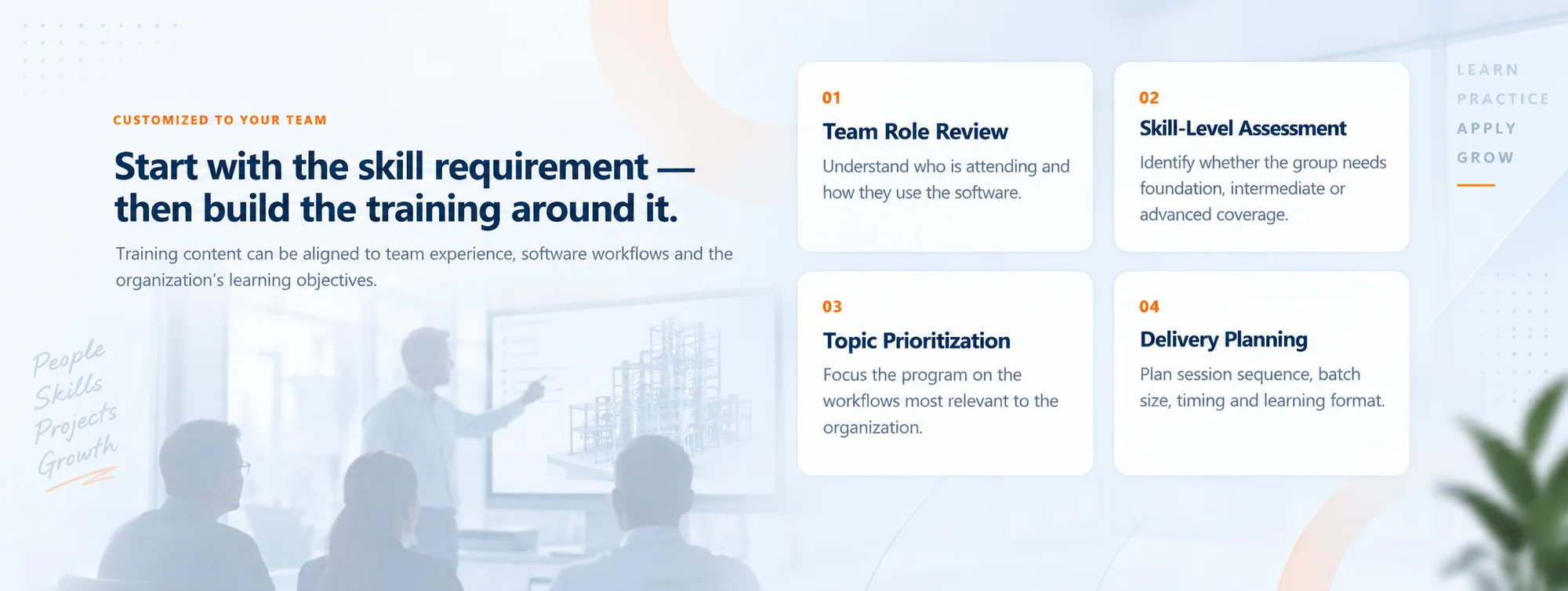
From Requirement Review to Training Completion
Requirement Review
Software, team roles, current knowledge and objective.
Skill Assessment
Appropriate level and priority areas for the batch.
Curriculum Planning
Modules, sequence, practical activities and schedule.
Training Delivery
Structured sessions with demonstrations and workflows.
Practice & Support
Reinforce workflows and clarify technical questions.
Completion
Close the plan and issue completion documentation.
Build a program around the organization's learning priorities.
Course Scope
Complete course, selected modules or focused technical topics.
Skill Level
Foundation, intermediate, advanced or mixed-experience teams.
Batch Size
Training structure adapted to team size and interaction needs.
Session Schedule
Plan sessions around project commitments and team availability.
Practical Exercises
Guided exercises relevant to the selected software workflows.
Assessment / Completion
Defined completion or assessment requirements where applicable.
Create a more consistent engineering software knowledge base.
Common Workflow Understanding
Help team members follow a more consistent approach to key software activities.
Role-Relevant Learning
Focus training on the responsibilities and workflows the team actually performs.
Faster Knowledge Development
Use a structured learning path instead of relying only on informal on-the-job learning.
Improved Troubleshooting Awareness
Help learners understand how to investigate common project and software issues.
Support for New Responsibilities
Prepare team members moving into administration, modelling or expanded project roles.
Scalable Learning Approach
Reuse a defined training structure for future internal batches where appropriate.
Tell us your software, team size and learning requirement.
We can structure a corporate training plan around your objectives.